
Knowledge · Water · 10/24/2026
Drinking rainwater: collection, storage and treatment
How our house lives on rainwater: a 101 m² roof, a 10 m³ concrete tank, a water balance based on Payerne weather data, water-saving fixtures and multi-step treatment up to a UV-C lamp.
The essentials in one image
 Enlarge the infographic
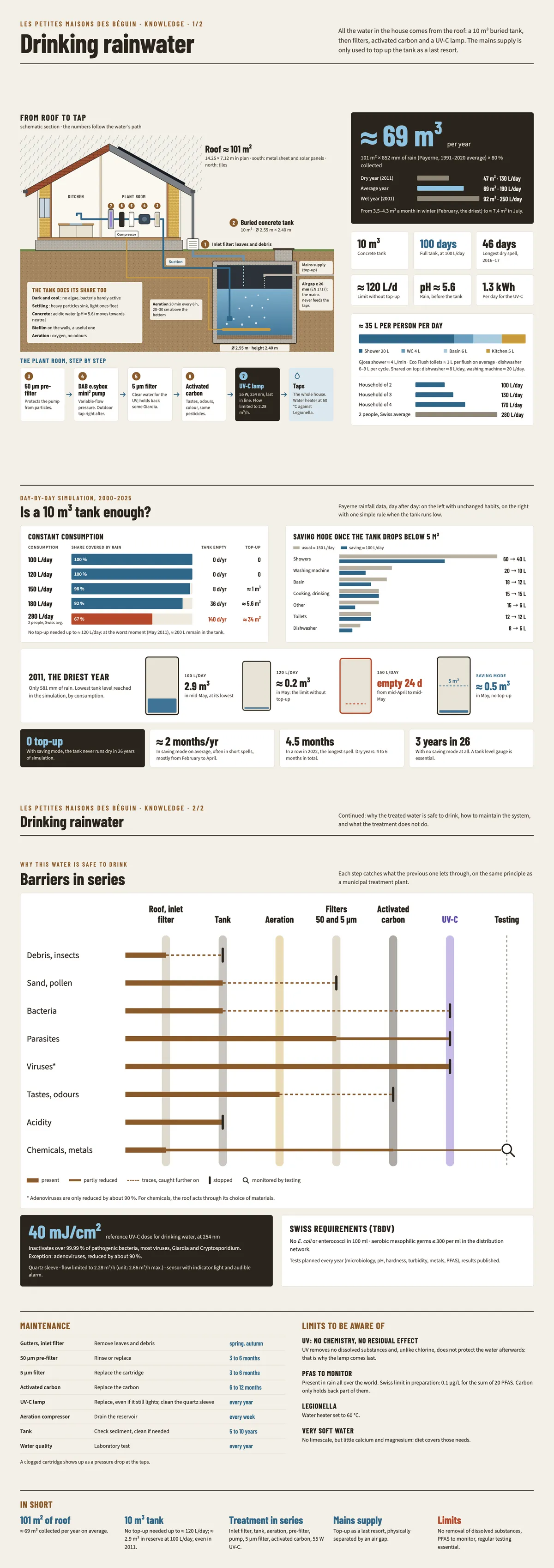
All the water that flows from the taps in our house comes from the sky. Rain falls on the roof, runs into a buried tank, then passes through a series of filters and an ultraviolet lamp before reaching the kitchen, the shower or the toilets. The mains supply is only a backup, used to fill the tank if it ever runs dry. This article explains how much water our roof can collect, how much we use, and why the treated water is safe to drink.
| Component | Choice |
|---|---|
| Collection area | Roof of the West house, ≈ 101 m² in horizontal projection |
| Average rainfall | ≈ 850 mm per year (MeteoSwiss, Payerne, 1991–2020) |
| Water collected | ≈ 69 m³ per year on average, or ≈ 190 L per day |
| Storage | 10 m³ cylindrical concrete tank, buried |
| Pressurisation | DAB e.sybox mini³ pump |
| Filtration | 50 µm pre-filter, 5 µm filter, activated carbon |
| Disinfection | 55 W UV-C lamp with flow limiter and alarm |
| Water-saving fixtures | Gjosa shower, Eco Flush urine-diverting toilets |
| Backup | Mains water, only to fill the tank |
Overview
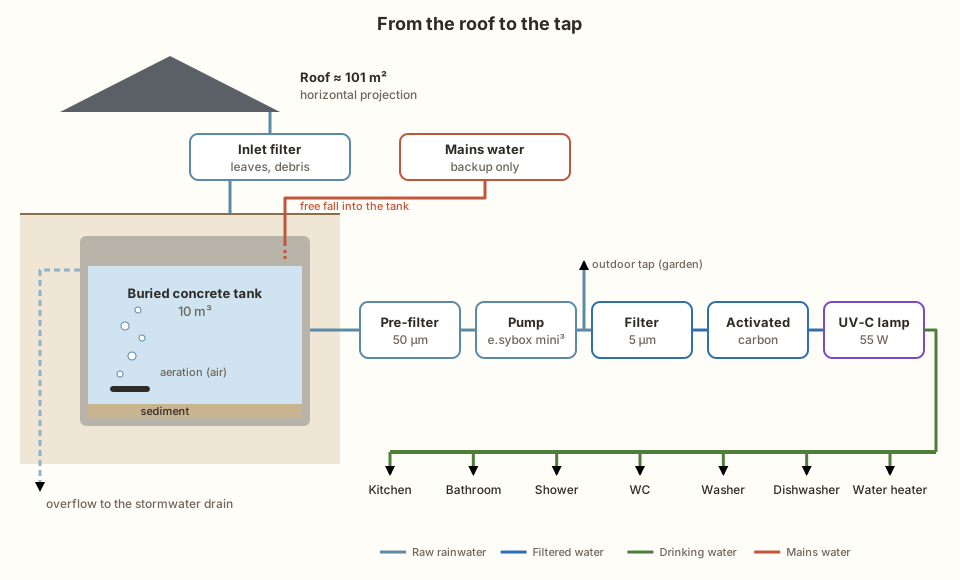
The installation follows the path of the water. Rain is first collected on the roof, then stored in a concrete tank where it settles. A pump then pressurises it and sends it through three increasingly fine filters, then past an ultraviolet lamp that disinfects it. The whole house is supplied with this water, including the water heater.
How much water falls on our roof?
The collection area
To calculate the water collected, we do not use the actual area of the roof slopes but their horizontal projection: the area the rain “sees” as it falls. Our roof measures 14.25 m long by 7.12 m wide, eaves included, or ≈ 101 m². Both slopes are connected to the tank: the south slope, covered with steel sheets and glass photovoltaic panels, and the north slope, covered with tiles.
Rainfall in the region
The nearest MeteoSwiss station with long measurement records is Payerne. Its daily measurements have been available as open data since 1964.
| Period | Rainfall in Payerne |
|---|---|
| Annual average 1991–2020 (climate normal) | 852 mm |
| Driest year since 2000 (2011) | 581 mm |
| Wettest year since 2000 (2001) | 1132 mm |
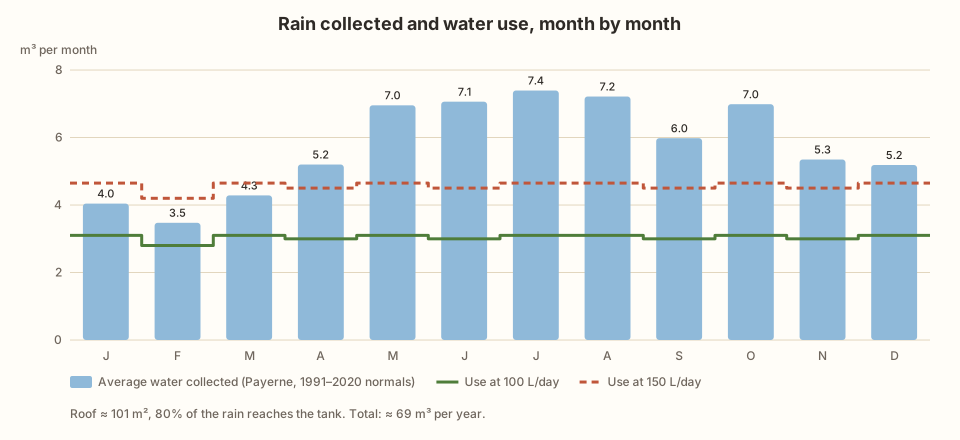
One millimetre of rain equals one litre of water per square metre. On 101 m², an average year therefore brings 101 × 852 ≈ 86 m³ of water. Part of it never reaches the tank, though: water that evaporates from a warm roof after a light shower, water that simply wets the tiles, water that overflows the gutters during heavy storms or is diverted by the inlet filter. We therefore apply a collection coefficient of 80%, a common value for a metal and tile roof.
| Year | Rainfall | Water collected (80%) | Per day |
|---|---|---|---|
| Average | 852 mm | ≈ 69 m³ | ≈ 190 L |
| Dry (2011) | 581 mm | ≈ 47 m³ | ≈ 130 L |
| Wet (2001) | 1132 mm | ≈ 92 m³ | ≈ 250 L |
Rainfall is fairly evenly spread over the year. January to March are the driest months, February above all, but even then our roof collects 3.5 to 4.3 m³ per month on average.
How much water do we use?
A Swiss household uses on average about 140 litres per person per day. Showers and toilets account for a large share: a conventional shower delivers 10 to 15 litres per minute, and an ordinary toilet uses 6 litres or more per flush.
We chose fixtures that greatly reduce these two items:
- The Gjosa shower splits the jet into fine, accelerated droplets. It still feels like a real shower with about 4 litres per minute, three times less than a conventional shower.
- The Eco Flush toilets (Wostman) separate urine and faeces. The front bowl, for urine, is rinsed with about 0.3 litres; the large flush, for faeces, uses about 2.5 to 3 litres. Since most toilet visits are for urine, average consumption drops to around one litre per flush.
- The Miele dishwasher uses about 6 to 9 litres per cycle, less than washing up by hand.
Here is an estimate of our consumption with these fixtures:
| Use | Assumption | Per person per day |
|---|---|---|
| Shower | Gjosa, 5 minutes at 4 L/min | ≈ 20 L |
| Toilets | Eco Flush, 4 small flushes and 1 large | ≈ 4 L |
| Washbasin | Hands, teeth, face | ≈ 6 L |
| Kitchen and drinking | Cooking, washing up by hand, drinking | ≈ 5 L |
| Total per person | ≈ 35 L |
On top of this come the appliances shared by the whole household: about 8 litres per day for the dishwasher (one cycle per day) and about 20 litres per day for the washing machine (three 45-litre loads per week). This gives:
| Household | Estimated consumption |
|---|---|
| 2 people | ≈ 100 L per day (≈ 50 L per person) |
| 3 people | ≈ 130 L per day |
| 4 people | ≈ 170 L per day |
These figures remain estimates. The meters installed on the circuit will let us check them in real conditions.
Is the 10 m³ tank big enough?
Comparing annual rainfall with annual consumption is not enough. It can rain a lot in autumn and hardly at all for six weeks in spring: the tank is the buffer between the two. To find out whether it is big enough, we simulated the tank day by day from 2000 to 2025, using the rain actually measured each day in Payerne. Each day, the rain fills the tank (the surplus goes to the overflow), then the household draws its consumption from it.
Average results over these 26 years:
| Household consumption | Share covered by rain | Days per year with an empty tank (average) | Mains backup (average) |
|---|---|---|---|
| 100 L per day | 100% | 0 | 0 |
| 120 L per day | 100% | 0 | 0 |
| 150 L per day | 98% | 8 | ≈ 1 m³ per year |
| 180 L per day | 92% | 36 | ≈ 5.6 m³ per year |
| 280 L per day (2 people at the Swiss average) | 67% | 140 | ≈ 34 m³ per year |
Up to about 120 litres per day, the 10 m³ tank would never have been empty a single day in 26 years. That is the limit, though: at 120 litres per day, only about 200 litres would have been left at the lowest point, in May 2011. Beyond that, the mains is needed from time to time, especially in dry years. Without the water-saving fixtures, two people using water like the Swiss average would depend on the mains a third of the time.
2011: the spring without rain
2011 is the driest year in the series since 2000, with an almost rainless spring from February to early May. It is the toughest test for the tank. To compare households from the same starting point, the chart starts with a full tank on 1 January:
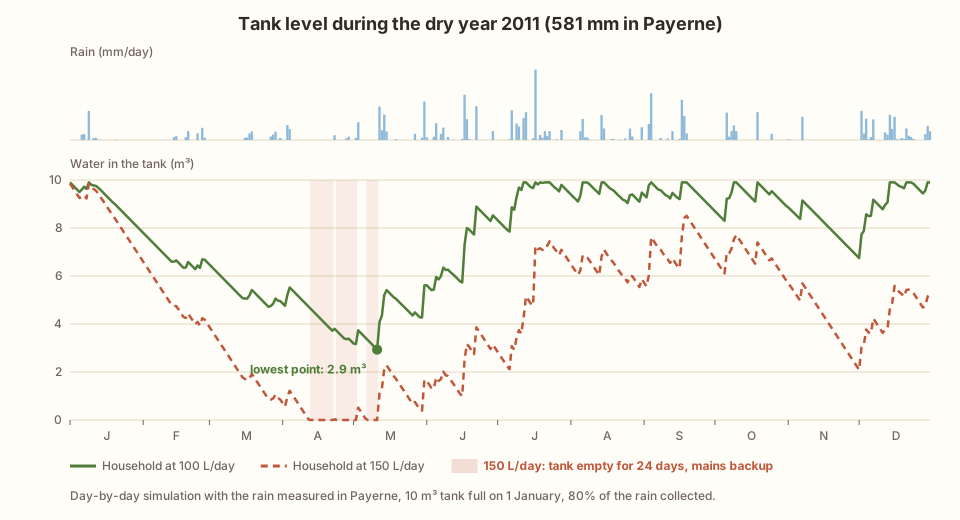
Another way to look at it: a full tank holds 100 days of consumption at 100 litres per day. The longest period without significant rain (less than 1 mm per day) measured in Payerne since 2000 lasted 46 days, from late November 2016 to early January 2017.
What about a shortage?
Take a three-person household that normally uses 150 litres per day: the ≈ 130 litres estimated above, plus about fifteen litres for cleaning and plants. In dry years, its tank would run empty from time to time. But nothing forces it to always use that much: when the tank level drops, it can be careful for a while. Our rule is simple: as soon as the tank falls below 5 m³, we switch to 100 litres per day, until it fills up again.
This is not about living in survival mode. The water-saving fixtures have already removed the waste, so what remains to cut is mostly comfort:
| Use | Usual | Saving mode | How |
|---|---|---|---|
| Showers | ≈ 60 L | ≈ 40 L | Shorter showers, about 3 minutes |
| Toilets | ≈ 12 L | ≈ 12 L | Nothing to change, the Eco Flush is already very frugal |
| Washbasin | ≈ 18 L | ≈ 12 L | Tap off while brushing teeth, a cup |
| Kitchen and drinking | ≈ 15 L | ≈ 15 L | Nothing to change |
| Dishwasher | ≈ 8 L | ≈ 5 L | Only when full |
| Washing machine | ≈ 20 L | ≈ 10 L | Grouped loads, one or two per week |
| Miscellaneous (cleaning, plants) | ≈ 15 L | ≈ 6 L | Cleaning with a bucket, no watering |
| Total | ≈ 150 L | ≈ 100 L | One third less |
With this rule, the 2000–2025 simulation gives:
- The tank would never have been empty, with no mains backup at all. At its lowest, in mid-May 2011, about 500 litres would have been left: the margin is thin in the worst years.
- Saving mode lasts two months per year on average, but rarely in one stretch: half of the episodes last less than eight days, until the next rain fills the tank again. In dry years (2010, 2011, 2017, 2022), it lasts four to six months in total, and up to four and a half months in a row, from late January to early June 2022. Only three years out of twenty-six did not need it.
- It mostly happens in late winter and spring, from February to April, and much more rarely in summer. January, February and March are the least rainy months of the year, and the tank has often not yet recovered by April. In summer, on the other hand, thunderstorms fill it quickly.
To apply this rule, you need to know the tank level: a level indicator is therefore essential. And the mains remains there as a last resort.
If the tank does run empty, a mains inlet can fill it. It is physically disconnected from the tank water: the pipe ends above the overflow level, and the mains water falls freely into the tank. Even if the mains pressure dropped, the rainwater could never be sucked back into the public network. The European standard EN 1717 requires a free fall of at least 20 mm, or twice the internal diameter of the pipe if that is greater. The taps in the house are never connected directly to the mains: they always receive water that has gone through the tank and the whole treatment chain.
Treatment, step by step
1. The roof and the inlet filter
Rainwater forms by condensation of water vapour in the clouds: at first, it is almost distilled water. It then picks up whatever it meets as it falls and on the roof: dust, pollen, Saharan sand, leaves, moss and above all bird droppings, the main source of bacteria.
A filter at the tank inlet holds back leaves and coarse debris before they reach the stored water.
2. The concrete tank: letting the water rest
The tank is a buried concrete cylinder 2.55 m in diameter and 2.40 m high. It does much more than store water:
- Darkness: without light, no algae can grow.
- Coolness: underground, the water stays cool all year round, far from the 37 °C at which intestinal bacteria thrive. They practically do not multiply there.
- Settling: in still water, sand and heavy particles sink to the bottom, while pollen and light particles float on the surface. The clearest water is in between.
- Neutralisation: rainwater is slightly acidic (pH ≈ 5.6) because it dissolves carbon dioxide from the air. In contact with concrete, it dissolves a little lime: its pH rises towards neutral and it picks up a little calcium. A new tank first does the opposite: during the first weeks, or even months, fresh concrete can push the pH above 9. That is why the pH is measured before drinking water from a new tank.
- Useful microbial life: a thin film of harmless bacteria forms on the walls. It consumes the organic matter dissolved in the water.
For these useful bacteria to stay active, the water must contain oxygen. Without oxygen, other bacteria take over and produce a rotten-egg smell. We are therefore installing aeration: a diffuser placed 20–30 cm above the bottom blows air into the tank for 20 minutes every 6 hours.
3. The 50 µm pre-filter and the pump
Just before the pump, a 50-micrometre pre-filter (0.05 mm) stops grains of sand and particles that could damage the pump.
The DAB e.sybox mini³ pump pressurises the water. It starts as soon as a tap is opened and adjusts its speed to keep a constant pressure, whether you are filling a glass or the shower and washing machine are running at the same time. The outdoor tap, for watering, is connected right after the pump: it does not need the rest of the treatment.
4. The 5 µm filter
This filter holds back fine particles down to 5 micrometres, about a tenth of the thickness of a hair. It makes the water perfectly clear, which is essential for the UV step: a bacterium hidden behind a particle would be in the shadow of the rays. It also retains some of the largest parasites, such as Giardia cysts (8 to 14 µm).
5. Activated carbon
Activated carbon is a plant-based charcoal treated to be riddled with microscopic pores: a single gram offers an internal surface of several hundred square metres. Dissolved organic molecules stick to it: this is adsorption. The carbon thus removes tastes, odours, colour and some chemical pollutants such as certain pesticides or hydrocarbons.
By removing organic matter, it also makes the water more transparent to ultraviolet light. On the other hand, bacteria can grow in the carbon itself. That is why it is placed before the UV lamp, never after.
6. The UV-C lamp: disinfection
The last step is a Eureka station fitted with a 55 W ultraviolet lamp. The water flows around the lamp, which is protected by a quartz sleeve. The lamp emits UV-C rays at 254 nanometres, a wavelength that the DNA and RNA of micro-organisms absorb very strongly. The rays damage this genetic material: bacteria, viruses and parasites can no longer reproduce. Unable to multiply, they can no longer cause disease.
Effectiveness depends on the dose received by the water, that is, the intensity of the lamp multiplied by the exposure time. For drinking water, the reference is 40 mJ/cm². At this dose, more than 99.99% of pathogenic bacteria are inactivated, such as E. coli, salmonella, Campylobacter or legionella. The parasites Giardia and Cryptosporidium, which resist chlorine, are on the contrary very sensitive to UV. Most viruses are also inactivated at this dose. Adenoviruses are the exception: at 40 mJ/cm², they are only reduced by about 90%. They are, however, human viruses, which have little reason to be on a roof (see below).
To guarantee this dose, the installation has two safeguards:
- A flow limiter set at 2.28 m³/h, below the station’s maximum flow (2.66 m³/h). Even with all the taps open, the water passes the lamp slowly enough.
- A monitoring cell that watches the lamp and triggers a warning light and an audible alarm if it fails.
UV adds nothing to the water: no chemicals, no taste. The lamp runs continuously and uses about 1.3 kWh per day, energy supplied largely by our photovoltaic installation.
Why is this water safe to drink?
Several barriers rather than one
No single step is perfect on its own. Safety comes from their succession: each barrier reduces a risk, and the next one catches what the previous one let through. It is the same principle as in municipal drinking water treatment plants.
| Risk | Origin | Barriers |
|---|---|---|
| Leaves, debris, insects | Roof | Inlet filter, settling |
| Sand, pollen, dust | Atmosphere | Settling, 50 µm and 5 µm filters |
| Bacteria (E. coli, salmonella…) | Bird droppings | Cool, dark tank, UV-C |
| Parasites (Giardia, Cryptosporidium) | Animals | 5 µm filter (partly), UV-C |
| Viruses | Rare in roof water | UV-C (partly for adenoviruses) |
| Tastes, odours, organic matter | Leaves, tank | Aeration, activated carbon |
| Acidity | Carbon dioxide in the air | Tank concrete |
| Chemical pollutants (PFAS…), metals | Atmosphere, roof materials | Choice of materials, activated carbon (partly), testing |
The viruses that make humans ill come mainly from human excrement, which has no reason to be on a roof. The microbial risk of roof water therefore comes above all from bacteria and parasites brought by animals, precisely those that UV treats best.
What the treatment does not do
UV disinfects but does not remove any chemical substance. Against dissolved pollutants, the protections are the choice of inert roofing materials and the activated carbon, which only removes part of them. Rainwater does, however, have one advantage over groundwater: it does not pass through the soil, so it does not pick up nitrates or seeped agricultural residues.
That does not make it pure: as it falls, it captures what is in the air, in particular PFAS, the “forever chemicals”. A study by Stockholm University showed in 2022 that rain contains them everywhere in the world, sometimes above the strictest limits set for drinking water. Switzerland is preparing lower maximum values, aligned with those of the European Union (0.1 µg/l for the sum of 20 PFAS). Activated carbon retains some of them, especially long-chain molecules, but not all: only a test can tell.
UV also has no residual effect. Unlike chlorine, it does not protect the water after it has passed the lamp. That is why the lamp comes last, just before distribution, and why regular maintenance is essential. For the same reason, the water heater must be set hot enough, at 60 °C, as in any house, to prevent legionella from growing in it.
Rainwater is also very low in minerals. This is not a health problem, as most of the calcium and magnesium we need comes from food. And it is an advantage for the house: no limescale in the water heater, the shower or the washing machine.
Checking with tests
Theory is not enough: only a laboratory test proves that water is drinkable. In Switzerland, the requirements are set by the ordinance on drinking water and water in public baths and showers (TBDV). For microbiological criteria, drinking water must contain no E. coli bacteria and no enterococci in 100 ml; these bacteria indicate faecal contamination. The number of aerobic mesophilic germs, a general quality indicator, must not exceed 300 per ml in the distribution network.
We have the tap water tested by a laboratory, for both microbiological and chemical criteria (pH, hardness, turbidity, metals, PFAS), and we will publish the results on this page.
Maintenance
A drinking water installation only works if it is maintained. Here is our programme, with indicative frequencies to be adjusted with experience:
| Component | Maintenance | Indicative frequency |
|---|---|---|
| Gutters and inlet filter | Remove leaves and debris | Spring and autumn |
| 50 µm pre-filter | Rinse or replace | Every 3 to 6 months |
| 5 µm filter | Replace the cartridge | Every 3 to 6 months |
| Activated carbon | Replace the carbon in the vessel | Every 6 to 12 months |
| UV-C lamp | Replace the lamp | Every year |
| Quartz sleeve | Clean | At each lamp change |
| Aeration compressor | Drain the reservoir | Every week |
| Tank | Check sediment, clean if needed | Every 5 to 10 years |
| Water quality | Laboratory test | Every year |
A UV lamp loses power over time, even while it keeps glowing: that is why it is replaced on a fixed date, without waiting for it to fail. A clogged filter cartridge shows up as a drop in pressure at the taps.
In summary
| Step | Role |
|---|---|
| 101 m² roof | Collect ≈ 69 m³ per year on average |
| Inlet filter | Stop leaves and debris |
| 10 m³ concrete tank | Store, settle, keep the water cool and away from light |
| Aeration | Keep the water oxygenated and odour-free |
| 50 µm pre-filter | Protect the pump |
| e.sybox mini³ pump | Pressurise the water |
| 5 µm filter | Make the water clear |
| Activated carbon | Remove tastes, odours and organic matter |
| 55 W UV-C lamp | Disinfect |
| Mains water | Fill the tank during prolonged drought |
With water-saving fixtures, our roof easily provides the water we need: at 100 litres per day, the 10 m³ tank would always have kept nearly 3 m³ in reserve since 2000, and up to about 120 litres per day it would never have run dry. The multi-barrier treatment makes this water drinkable, and regular tests make it possible to check it.